In 1611 the States of Holland called six Remonstrant and six Reformed ministers to The Hague to debate the five articles the Remonstrants had set out the year before: on election, on the extent of Christ's redemption, on the cause of faith, on the manner of conversion, and on whether believers can fall away. The proceedings of the Collatio Hagiensis were printed, and the dispute that followed led to the Synod of Dort (1618–19).
William Ames (1576–1633), a student of William Perkins who had left England for the Netherlands, wrote the Coronis, the “finishing touch” or crown, to that conference. Taking the Remonstrants' written answers one by one, he defends the Reformed pastors' arguments against each of their exceptions. The Elzevir press in Leiden published it in 1618, as the Synod gathered, and it was reprinted in London. Ames went on to teach at Franeker and to write the Marrow of Theology, but the Coronis, his main contribution to the controversy that shaped the Canons of Dort, has never been published in English.
- IOn Election from foreseen faith
- IIOn Universal Redemption
- IIIOn the Cause of Faith
- IVOn the Manner of Conversion
- VOn Uncertain Perseverance
Sententia Remonstrantium hæc est: DEVM æterno & immutabili decreto, in Iesu Christo Filio suo, ante jactum mundi fundamentum, statuisse, ex lapso & peccatis obnoxio humano genere, illos in Christo, propter Christum, & per Christum, servare, qui Spiritus Sancti gratiâ in eundem Filium ejus credunt, & in ea fide fideique obedientiâ per eandem gratiam usque ad finem perseverant.
Fricanda paululum est hæc spica, ut ambiguitatum omnium integumentis remotis, quid grani contineat, facilius possit intelligi, & quid illud sit de quo disseratur.
The opinion of the Remonstrants is this: that God by an eternal and immutable decree, in Jesus Christ his Son, before the foundation of the world was laid, determined, out of the fallen human race subject to sin, to save in Christ, for Christ's sake, and through Christ, those who by the grace of the Holy Spirit believe in this his Son, and who by the same grace persevere in that faith and in the obedience of faith unto the end.
This ear of grain must be rubbed a little, so that, once the husks of all its ambiguities have been removed, it may more easily be understood what kernel it contains, and what that is which is under discussion.
A translation is only as good as the Latin it is made from. Early printed books reach us as photographs of worn pages, and a single transcription of a single copy carries that copy's blots, the printer's slips, and the transcriber's own misreadings straight into the English. So before anything was translated, we transcribed two editions of the Coronis in full, the Leiden first edition of 1618 and the London edition of 1632, and compared them word by word. Wherever they differed in a way that could change the meaning, both printed pages were examined again before anything was decided.
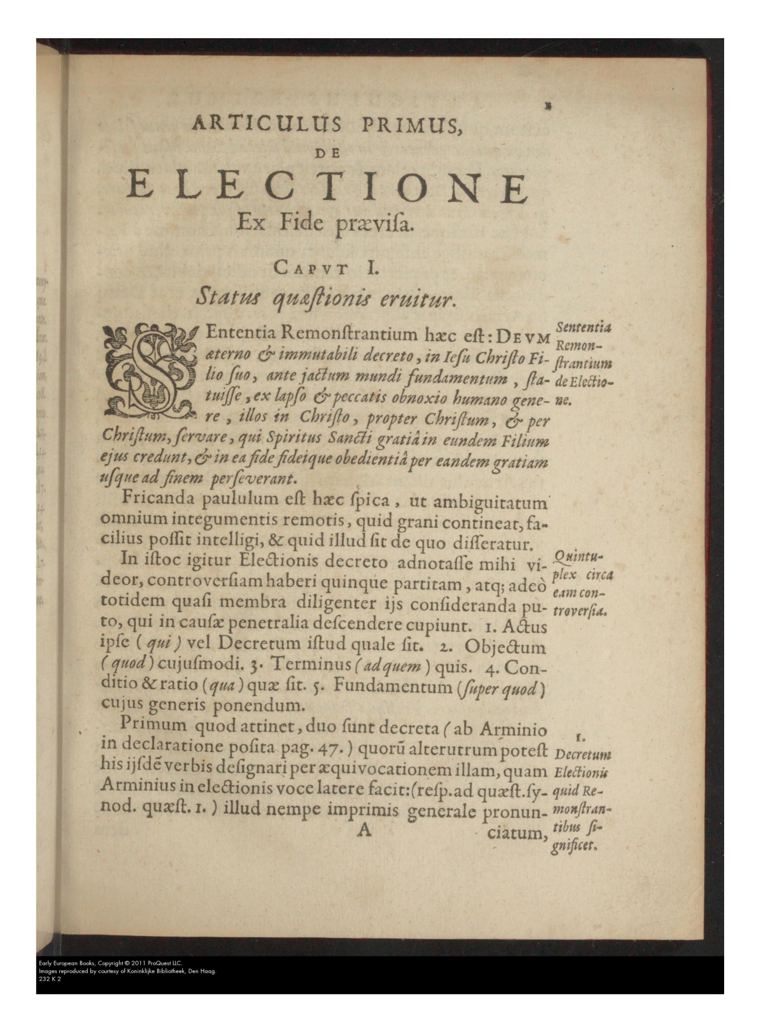
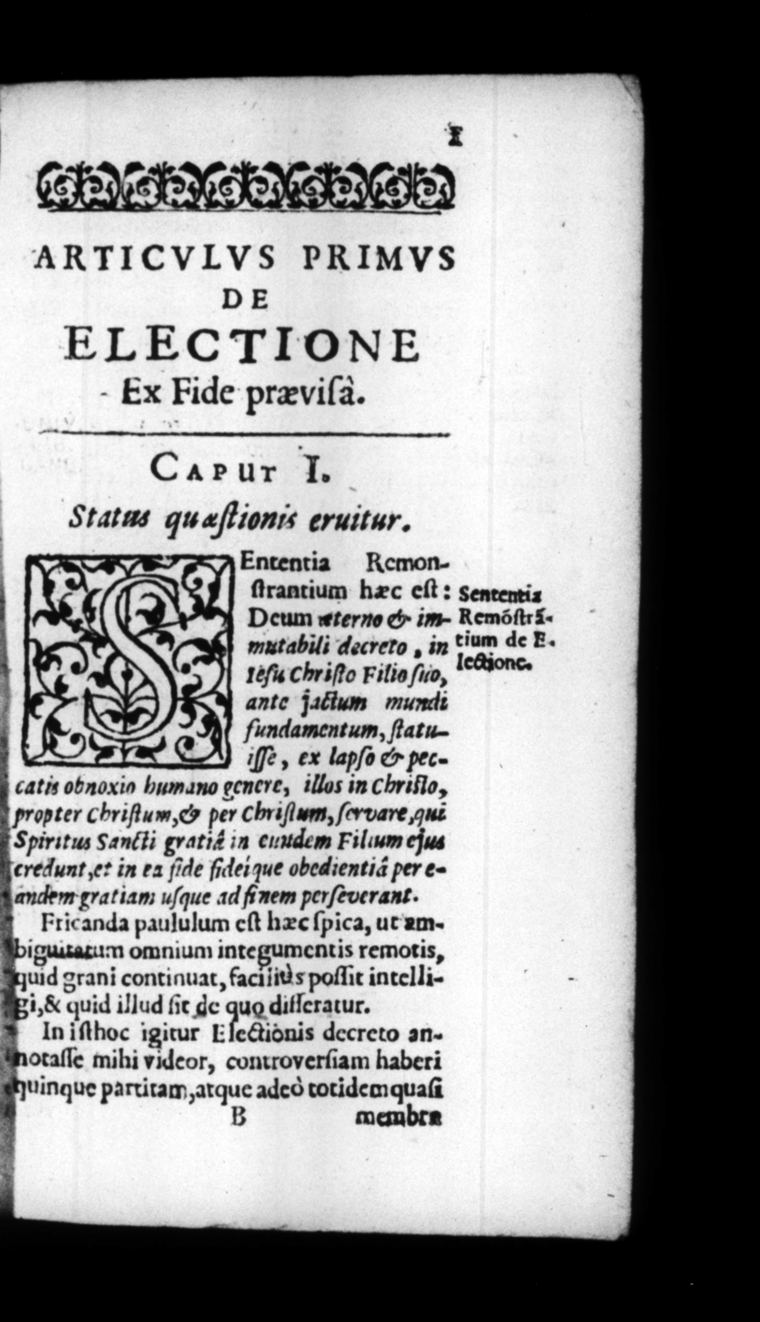
The same page, two printings
The opening of Article I in the Leiden first edition and in the London edition of 1632. The words are almost all the same; the type, the spelling and the line breaks are not. Comparing two printings separates what Ames wrote from what one printer, or one photograph, did to it.
A printer's error that reversed Ames's meaning
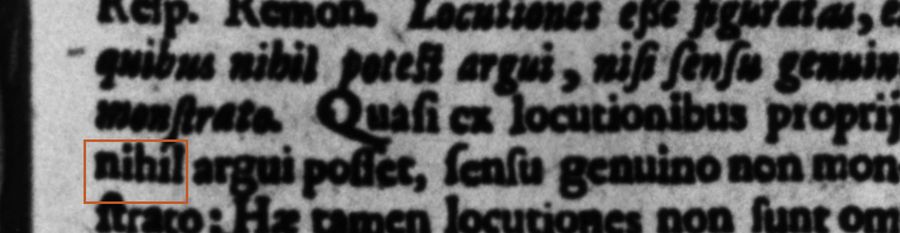
In Article IV, Ames answers the Remonstrants' claim that nothing can be argued from figurative language in Scripture unless its true sense is first shown. His retort, as the 1618 edition prints it, reads non nihil, “something,” which turns his sarcasm into its opposite. The book's own list of errata, printed with the first edition, says to delete the non, and the London edition of 1632 prints the corrected text. The translation follows the corrected reading.


Text a single reading would have lost
Near the end of Article V, the first transcription of the 1618 edition passed over several stretches of text. The London edition had them, so the gap showed up as a difference between the editions, and the 1618 page itself confirmed the words are printed there. In all, 27 such passages were restored before translation. Without a second edition to compare, the English would have run straight past them.

Then the translation
The established Latin was translated passage by passage, 434 passages in all, each checked afterwards against its Latin for anything left out or added. In Commonplace, every passage of the English sits beside the Latin it was made from, and the side panel follows as you read. The full record of the comparison, including every reading in which the 1632 edition differs, is kept with the text.
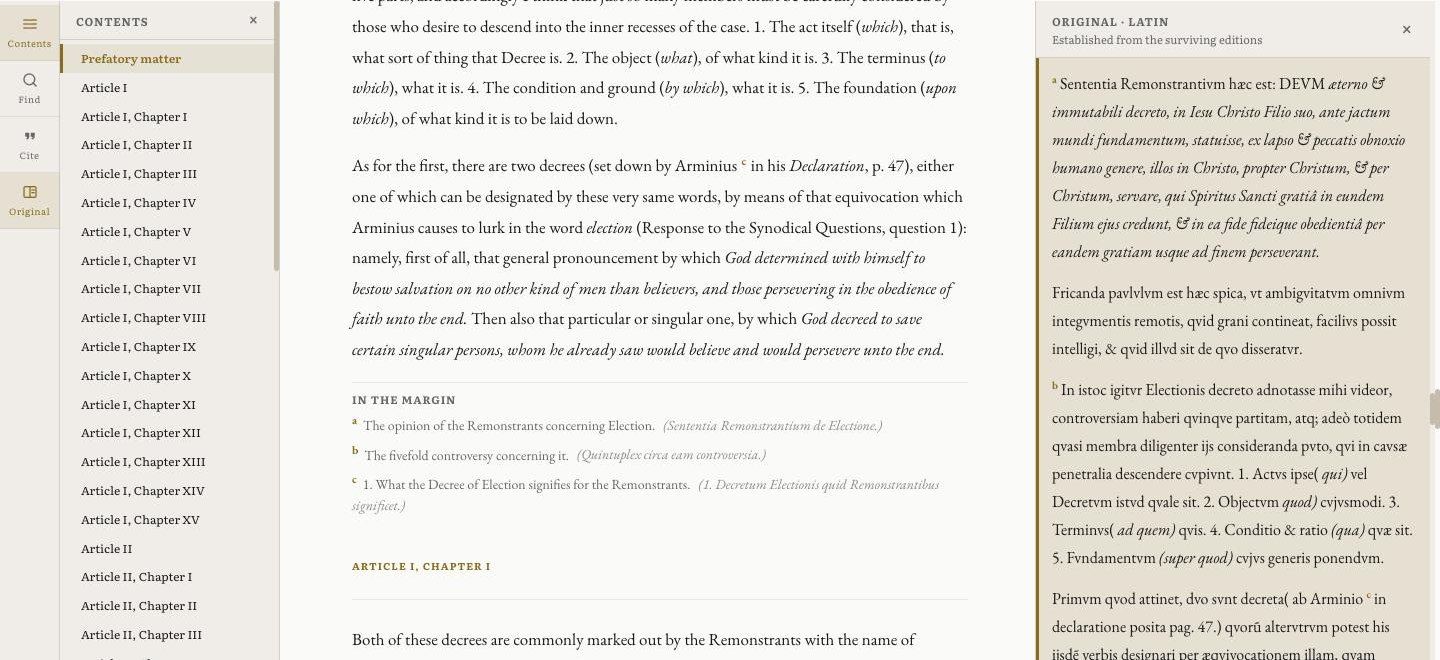
The English translation runs down the middle of the page. Beside it, the Latin of the 1618 first edition follows along as you scroll, with the passage you are reading highlighted, so any sentence can be checked against what Ames actually printed. His side notes, printed in the margins of the original, appear under each passage in English with the Latin beside them.